Inside the Laundry Label: Symbols, Words, and the Safest First Read
Read a garment’s care label in order, decode the common wash and drying symbols, and choose a cautious routine when instructions are unclear.
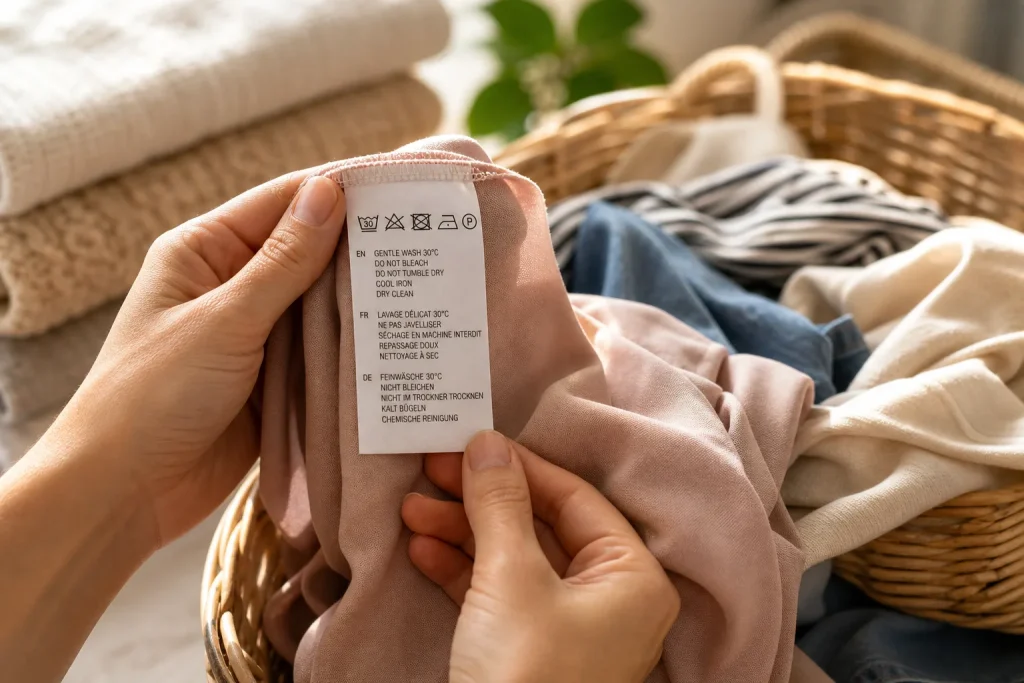
You’re holding a new shirt over the laundry basket, and its label is a row of tiny pictures you can barely make out. Before you reach for the detergent, turn the label towards the light and read it from left to right. Those instructions are written for that garment as a whole, so they’re a better starting point than a guess based on its fabric or colour.
Where should you start reading?
Look for the permanent care label, usually sewn into a side seam, near the hem or at the back of the neck. Some garments have more than one label: one gives fibre content and another gives care directions. Find the care information, then check that it belongs to the item in your hands. A detached label or instructions copied from a similar-looking garment may not describe its lining, trim, fastenings or finish.
Read every line before choosing a wash cycle. Care labels often combine words and symbols, and a written warning can matter as much as the row of icons. If you find more than one language, use the wording you understand rather than trying to infer a direction from a blurry symbol.
Start with the garment’s main care instruction, then look for limits on water temperature, bleach, tumble drying, ironing and professional cleaning. These are separate decisions. A garment might be washable but not suitable for a tumble dryer, or safe to iron only at a low setting.
What do the washing symbols tell you?
The tub-shaped symbol refers to washing. A number inside it, when present, marks the maximum water temperature. Treat it as an upper limit, not a target: a colder wash may be appropriate if it also cleans the garment and suits the detergent. Lines beneath the tub indicate a gentler wash process. More lines mean a more delicate treatment, such as a reduced-action cycle.
A hand inside the tub means hand wash. Follow any accompanying temperature instruction, use a clean basin or sink, and move the garment gently through the water rather than scrubbing or twisting it. If the label says not to wash, don’t put the item through a machine or hand wash it; check whether another cleaning method is given.
A cross over a symbol means that action is not allowed. Look carefully: a crossed tub is not the same as a tub with a low temperature, and a crossed tumble-dryer symbol is not a suggestion to choose a shorter cycle.
How do you read drying and ironing directions?
A square with a circle inside refers to tumble drying. A cross through it means do not tumble dry. Dots inside the circle indicate a heat setting: fewer dots call for lower heat, while more dots permit a hotter setting. If you’re unsure whether your dryer has a suitable setting, choose a drying method allowed by the rest of the label instead.
A plain square gives information about natural drying. Lines inside it can show how to dry the garment: a horizontal line commonly indicates drying flat, while a vertical line commonly indicates hanging it to dry. A curved line at the top can indicate hanging on a line. Check the complete symbol, including any marks you may have missed, before you move the item from the washer.
The iron-shaped symbol gives ironing guidance. Dots indicate the permitted heat level, and a cross means do not iron. When a label allows ironing, use the setting that matches its instruction and begin on a less visible area if the garment’s surface might be delicate. Keep the iron moving, and avoid pressing directly on a raised print or decorative detail unless the label says it is safe.
What do bleach and professional-cleaning symbols mean?
A triangle refers to bleach. A crossed triangle means do not bleach. Other marks inside the triangle can specify which type of bleach is permitted. If the symbol is unclear, leave bleach out rather than assuming a household product is suitable. A detergent marked as colour-safe or gentle is not automatically the same thing as a bleach instruction.
A circle relates to professional cleaning. Letters inside it give information to a cleaner about the process or solvents; for most home laundry decisions, the useful point is whether the symbol is crossed out or whether the label’s words say to use a professional cleaner. Don’t try to translate specialist instructions into a home dry-cleaning method. If the garment says dry clean, take it to a professional and point out any visible stain.
Some labels combine a symbol with a plain-language instruction such as “dry clean only” or “do not wring”. Follow the wording as well as the icons. If instructions appear to conflict, pause and ask a professional cleaner rather than choosing the more convenient interpretation.
How should you turn the label into a laundry routine?
Once you’ve read the whole label, make each decision in order. First, separate garments according to the care they need, not just their colour. Then set the water temperature and cycle to fit the label. Choose detergent suited to the item and the washing method, and leave out products the label rules against. Before loading the machine, close zips and fasten hooks if that helps prevent snagging; put a delicate item in a mesh laundry bag only if it can be machine washed.
After washing, read the drying instruction again. It’s easy to remember the wash setting and overlook the square symbol. If the label says to dry flat, use a clean, dry towel or a drying rack that supports the garment evenly. If it permits hanging, use a hanger or line in a way that won’t pull a wet, heavy garment out of shape. Follow the iron instruction only after the garment is dry enough to press safely.
Say you have a blouse labelled for a gentle, cool wash, with a crossed tumble-dryer symbol and a direction to dry flat. You could place it in a mesh bag, select a gentle cold cycle, then lay it on a clean towel or drying rack instead of putting it in the dryer. The observable result to look for is a blouse that dries without being exposed to the prohibited heat or pulled out of shape while wet. The label still takes priority if it includes another instruction, such as hand washing.
What if the label is missing or hard to read?
First, check another seam and look for a second care tag. You might be able to read a faint symbol using your phone’s torch or camera zoom, but don’t rely on an online image of a similar product as a substitute for the garment’s own directions. Details can vary between styles, colours and versions of a garment.
If the label is unreadable, use the least aggressive approach that makes sense for the item, and avoid irreversible choices such as hot water, strong bleach or tumble drying. For an expensive, structured or decorated garment, ask a professional cleaner before washing it. If there’s a visible stain, tell the cleaner what caused it if you know; avoid rubbing it or adding a treatment that could set or spread it.
You can keep a small note in your phone for items whose labels are likely to fade, but record the wording while it is still legible rather than relying on memory. A clear photograph can also help, especially when the symbols are printed in a small typeface.
What is the safest first read?
Use the label as a sequence of permissions and limits: wash, dry, iron, bleach and professional cleaning. Don’t treat a single symbol as approval for every part of the process. A washable garment still needs the right drying method, and a permitted iron setting doesn’t cancel a warning about a delicate finish.
When a direction is unclear, pause before the garment reaches the machine or dryer. That small check is useful because washing decisions are easiest to change before water, heat or stain treatment has been applied. Keep the label attached where possible, and let its instructions guide the next wash rather than guessing from habit.